Wednesday, January 29, 2014

Could this happen where you live?


HOUSE 00000

An Actual Winter Weather Scenario

Would you be prepared for the unexpected?

Since it is winter, lets look at a scenario  that happened to me here in my small town a few years back. We had a large ice storm which brought down trees and power lines throughout the state. Only about 10% of our town had electricity . The rest of us went without for as much as a week for most of us.
Now I am not a prepper by any means but my family and I got through this with little impact. Here is how we did it.  By the way, the photo above is an actual photo of a huge tree that came down across the street
The power went out in the mid afternoon time frame. The freezing rain started breaking trees and the almost constant sound of large tree limbs breaking made you cringe. As the power remained off into the evening, people in our town were starting to get cold in their home…and hungry. The emergency operations center here in town opened up shelters which included the university buildings and gym which I have never seen used as a shelter before. The breaking trees after dark got louder and broke more often. you wouldn’t believe how loud they were…and you hoped that pretty tree out front did not fall into your home.
As it was getting toward dusk, the first round of neighbors were leaving  for the shelters or trying to go into Lexington which was experiencing the same effects but more of the city had electricity than we did. My neighbor across the street packed his bags and he, his wife and mother in law headed out to find a hotel with power about 30 miles away.
Once it got dark , it was apparent that the power was probably not going to come on any time soon so I went to a friends house to ask him to come over with the wife and kids. As I arrived at his house, he was walking out the door with his son to go to a shelter,(by the way, his wife was at work….at the County Emergency Operations Center). He was happy to take me up on my offer.
I happen to have a generator that I bought in 1999 (with “W”‘s 400 bucks he gave us as a stimulus) and I have a free standing wood stove in our basement family room and a fire place upstairs. I also have about two years worth of firewood at all times. I get free tree stumps already cut by finding someone that has cut a tree down. They are happy to have someone haul it away. Each summer, I split the wood (yes I use a wood splitter) and stack it away to cure. I have not always had a place to burn wood. Previously I used a couple of kerosene heaters (the round ones put out the most heat and you can cook on them too).
To get to the point, I was the ONLY one in our area that had power from the generator, heat in the house, hot food on the table (cooked on the wood stove and the charcoal grill), had overnight guests sleeping over and we were watching Directv. It also was nice to have lights in the bathroom :)
I ran the generator in the evening and shut it off while we slept. then again for a couple hours each day. This kept my refrigerator and freezer from thawing out my food. Most people lost all their perishable food, including the grocery stores. What a mess that was. The fire from the big wood burner in the basement kept the house at 70 degrees all night. Having power for coffee the next morning was wonderful. We made several pots and offered them to neighbors that were still home.
As the next day went by, I would see more and more people that stayed at home during the first night leaving for shelters. People were also scrambling to find generators…and then trying to find gas for them since the gas stations had no power. My next door neighbor finally found one on the 5th day in another town. Just as they were pulling in their driveway with the new generator, our power came back on.
That was back in 2007 I believe….but would you believe that generator is still in the box in their garage!! They do not know if it works or not. they have no fuel stored away (and rotated with fresh) in case it happens again. I have offered several times to get it out and check it over but they have not taken me up on the offer.
Soo , all in all my family and a few friends came through  the ordeal with little impact… not because I am a prepper but because I look at life as a Boy Scout ….just being prepared.
You do not have to go out and spend a lot of money to get everything at once. it is a progression from the most simple basic things and upgrading as you need or can afford. I started with no generator then graduated to old broke down generators I tried to keep running until I put back enough money for a good one (with “w”‘s help mentioned above). The firewood is free and gives me good exercise. I was fortunate to have a wood stove and fire place but in a previous house, we heated with a kerosene heater when the power went out one winter….although the power was not off near as long.
In the coming posts, I will be giving tips on how to get by with the absolute basics and you can upgrade from there when you feel the need. I will tell you how to stay warm, feed the family,have light at night, charge your phones …all without the power grid being up and  spending very little money to do it. The truth is that many of you have the things you need already, you just do not know how to use them…because the need never arose.
I am sorry for the long post but I hope by sharing an actual event, I have interested others to forecast and plan for times that they may have to do without. It isn’t hard…and can be done on the cheap. It is like a hobby once you get started
More to come with suggestions and ideas for all to get started…or at least thinking about it
Dan 

Sunday, January 19, 2014

Thieves are not stupid

Although this post is not directly related to preparedness, I thought it would be a good idea to post this info for the general benefit of others.

Here are some examples

  1.  Some people left their car in the long-term parking at San Jose while away, and someone broke into the car. Using the information on the car's registration in the glove compartment, they drove the car to the people's home in Pebble Beach and robbed it. So I guess if we are going to leave the car in long-term parking, we should NOT leave the registration/insurance cards in it, nor your remote garage door opener.
This gives us something to think about with all our new electronic technology.

  2.  GPS.
 Someone had their car broken into while they were at a football game.  Their car was parked on the green which was adjacent to the football stadium and specially allotted to football fans.  Things stolen from the car included a garage door remote control, some money and a GPS which had been prominently mounted on the dashboard.  When the victims got home, they found that their house had been ransacked and just about everything worth anything had been stolen.  The thieves had used the GPS to guide them to the house.  They then used the garage remote control to open the garage door and gain entry to the house.  The thieves knew the owners were at the football game, they knew what time the game was scheduled to finish and so they knew how much time they had to clean out the house.  It would appear that they had brought a truck to empty the house of its contents.

 Something to consider if you have a GPS - don't put your home address in it... Put a nearby address (like a store or gas station) so you can still find your way home if you need to, but no one else would know where you live if your GPS were stolen. Personally, I use the exit ramp as my home destination. I think I can find my way home from there :) Don't forget to NOT let your GPS on your phone log your home address or location for map or navigation programs

 3.  CELL PHONES
     This lady has now changed her habit of how she lists her names on her cell phone after her handbag was stolen. Her handbag, which contained her cell phone, credit card, wallet, etc., was stolen.  20 minutes later when she called her hubby, from a pay phone telling him what had happened, hubby says 'I received your text asking about our Pin number and I've replied a little while ago.'  When they rushed down to the bank, the bank staff told them all the money was already withdrawn.  The thief had actually used the stolen cell phone to text 'hubby' in the contact list and got hold of the pin number.  Within 20 minutes he had withdrawn all the money from their bank account.

    Moral of the lesson:
   a.  Do not disclose the relationship between you and the people in your contact list.  Avoid  using names like Home, Honey, Hubby, Sweetheart, Dad, Mom, etc....
   b.  And very importantly, when sensitive info is being asked through texts, CONFIRM by calling back.
   c.  Also, when you're being texted by friends or family to meet them somewhere, be sure to call back to confirm that the message came from them.  If you don't reach them, be very careful about going places to meet 'family and friends' who text you.

  Purse in the grocery cart scam...
       A lady went grocery-shopping at a local mall and left her purse sitting in the children's seat of the cart while she reached something off a shelf.  Her wallet was stolen, and she reported it to the store personnel.  After returning home, she received a phone call from the Mall Security to say that they had her wallet and that although there was no money in it, it did still hold her personal papers.  She immediately went to pick up her wallet, only to be told by Mall Security that they had not called her.  By the time she returned home again, her house had been broken into and burglarized.  The thieves knew that by calling and saying they were Mall Security, they could lure her out of her house long enough for them to burglarize it.

With today's technology, stop and think about how easy it is to access personal info to a thief. I bet most people do not have a pin to unlock their cell phone or some "cryptic" way of knowing what info in your phone / GPS is without giving a thief enough info to cause further damage or danger to others by obtaining it

Just something to ponder :)
Dan

Saturday, December 7, 2013

Easy and affordable cooking with Stove in a Can

As I write this post, we are waiting on a winter storm that will arrive tonight. The weather service is "forecasting"  that where I live will be more of a freezing rain event rather than a large snowfall like Southern Indiana will receive.
Stove in a can

The last ice storm caused the power lines to go down and we lost power in my entire town of 36K people...except for one very small area of town for a week. We have a generator so we did pretty well and didn't lose anything in our freezers. We are all electric so we could not cook. My generator is not big enough to run our electric stove however we do have a wood burning stove that kept us warm and we cooked on it....heck, we invited the neighbors over...we were the only ones with a generator, heat and something hot to eat :)
The reason I mention this is because I have found a product that can be used to cook in most any scenario. It is called "Stove in a Can" and I feel is extremely affordable to keep handy...even if you live in an apartment.
The details are below, Yes I do carry this product and I will gladly sell you one but again, the purpose of the blog is to educate rather than be an ad for my products. There will be times such as this when I think a product fills a need for many and worthy of putting on this blog as well as a product I would like to offer for anyone that visits the store.

Check it out, I really like the product, not hazardous, reusable, small, long burning.....heck, it even comes with the waterproof matches inside the can!
If you do purchase one from where ever, please leave some comments here to let us know if you like it
Enjoy
Dan

Stove In A Can is a portable, self-contained cooking platform that provides a week's worth of cooking. Virtually anything that can be cooked on a regular stove can be cooked on a Stove In A Can.

  • Cooks for 4-6 hours (1 week's worth of cooking time)
  • Boils water in 5 minutes
  • Holds over 300 lbs
  • Stores indefinitely and safely (no chemicals)
  • Can be lit and re-lit
Safe - Non-explosive, non-hazardous, and clean-burning fuel means you can take it, store it, and cook on it wherever you need it. Because it is so much safer, there is no legal limit as to the quantity you can store in your home like there is for other fuels.
Reliable - Has an indefinite shelf life and works great in extreme weather conditions. Fuel cells are completely waterproof and will ignite in seconds, making it great for emergencies, or for camping and other recreational uses.Stove in a can
Superior Performance - Boils water in less than five minutes and cooks for over an hour on a single fuel cell. Since most meals only require 15 minutes of cooking, that is almost 1 weeks worth of cooking. At up to 18,000 BTU's, it burns hotter than most other outdoor stoves.
Convenient - Compact, lightweight, and ready for cooking in less than a minute. Includes fuel, platform, cooking rings and waterproof matches so it is ready when you need it.

Tuesday, November 26, 2013

Surviving An Unexpected Emergency

One of the very basic tenets of preparedness is to routinely evaluate risks that are specific to your geographical area.  But what happens when Mother Nature throws you a curve ball and the unexpected emergency occurs?

Today I would like to share the experience a Colorado reader who experienced first hand the devastating floods in Colorado.   “Jeff C.” was kind enough to send me his up close and personal experience during the recent Colorado floods.  Is he a prepper?  Yes.  Was he as prepared as he could be?  He thought so.  Read on.

Survival Friday: Surviving An Unexpected Emergency   Backdoor Survival

A Retrospective After the Colorado Flood

First note. Something can happen at any time, any moment. A derailed train of nasty chemicals, a toxic spill in your sewer, a factory in your area has a fire or explosion spewing deadly fumes, or a hundred unexpected man made disasters. (Not even to get into all of the geopolitical options, riots, civil unrest, flash mobs, etc.) Also there are fires, earthquakes, tornadoes, or FLOODS.

Here in the mountains of Colorado we don’t expect floods. We barely get rain most of the time. (This has more often than not let to multiple evacuations for fire.) We occasionally hear “Flash flood” warnings but those are usually “For those folks down there.” Needless to say we never would have imagined, let alone expected what happened.
3:00 am. KNOCK, KNOCK, KNOCK!!

Fireman at the door. Our house is surrounded by water. What was a 6’ wide creek 50 yards BEHIND our house, now has at least 2 ½ ft. of RUSHING water as far as 60 ft. IN FRONT of our house. Both of our cars are in the flow and cannot be reached. (One of them was eventually washed completely off the driveway.) The fireman informs us that we have a few minutes to gather some things while they get 4×4 backed in over at the next door neighbor’s house (Because they can’t get it close enough to our house) they are going to have to escort us through some “lower” water right next to the house, over to the next house…We will have what we can carry…a few minutes to grab it.
Myself. My wife & two teenage daughters, and a dog.

Quick check of the situation. I look in the garage. There is already 10” of water inside at the garage door itself, with the slant of the floor the water is nearing the entrance to the interior of the house but shallower there. We have already lost personal property, heirlooms, etc and the news is only 1 minute old.

We ended up with 1 small backpack for each of the girls and my wife and I (And the dog – He will need some food) shared one backpack and I grabbed my office bag with my laptop (Besides being my livelihood, it is my employer’s property and there are sensitive documents.)
What did we grab…?

A change of clothes, some basic toiletries, prescriptions, phones and chargers, the documents (Birth certificates/Passports etc) from the fireproof box, some dog food, a handgun, and some ammo….TIME TO GO!

They got us out and dropped us on the other side of the water. There you are.
I thought I was fairly light and mobile. I’m not. Or at least to the degree I should be. A lot of things happened after that and compared to many others we are doing fine. We have been blessed a hundred times throughout this. However, I am resolved to make some changes. Everyone, including the dog is going to have a bug-out bag. There needs to be some other considerations as well. Most importantly, we are safe, but there needs to be some changes made in our house.
Some things to think about…

We had boxes on shelves in the garage but the water was already above the bottom shelf…Books are heavy, so you put them on the bottom shelf. They are first to go in a flood.

DO NOT KEEP YOUR NIFTY EMERGENCY WATER PURIFIER ON THE FLOOR OR BOTTOM SHELF (Why would this be so fresh in my mind?)
The fireman instructed us to leave our house unlocked. There were things about that which I was not prepared for or comfortable with. Think about it. The way your house/belongings are RIGHT NOW, would you be comfortable walking away leaving only as secure as they currently are?

We were dropped off, but then got a ride to a temporary shelter. Who would you call? Who would call you?
We lost cell service, most land lines, some people had land lines but no internet, some people only had internet, some people had only walkie-talkies, many had nothing…where are your phone numbers even if you had a phone?

The flood cut off our mountain town with some roads to be out for weeks, some months, some (?)…There was a question of how food and gas supplies would get to us, but for us, that came around after 3 days there was a LONG way out/in.

I could go on and on. Others had MUCH more hazardous situations than us and I’m sure they would have more/different thoughts. I just thought I would share mine.
Jeff C.
Estes Park, CO

Bugging Out is Sometimes Required

In recent weeks I have gone to great lengths to explain that bugging in is always preferable to bugging out.  That said, even with adequate food, water, power, and fire/heat, when the knock comes, you must be ready to go.  As Jeff so aptly states, you may only have minutes.
As an exercise today and throughout the weekend, think about those things that you would grab if you only had minutes in which to evacuate your home.  Where are they located and could you get to them?  And perhaps more important, do you have a bug-out bag for every family member and has it been inventoried and updated lately?

The Final Word

When I asked Jeff for permission to post his experience on line at BDS, he said:
If it helps someone else learn some of the things I had to learn the hard way, ahead of time, it is worth it.
As his experience teaches us, no matter how knowledgeable we might be, learning from the real life experiences of others will help us take our prepping journey to the next level.  That, plus the knowledge that stuff is just stuff, after all.  It is family and loved ones that are most important.
Enjoy your next adventure through common sense and thoughtful preparation!
Gaye
If you have not done so already, please be sure to like Facebook which is updated every time there is an awesome new article, news byte, or link to a free survival, prepping or homesteading book on Amazon.  You can also follow Backdoor Survival on Twitter, Pinterest, and Google+.
In addition, when you sign up to receive email updates you will receive a free, downloadable copy of my e-book The Emergency Food Buyer’s Guide. 
Survival Friday: Surviving An Unexpected Emergency   Backdoor Survival
Bargain Bin:  Putting together a bug-out-bag is not a one-size-fits all proposition.  Still, there are some basic foundation items that belong in every kit.  Sure, you still need to add food, water, personal care items and a whole lot more. But these basics will get you started.
Rothco Medium Transport PackSurvival Friday: Surviving An Unexpected Emergency   Backdoor Survival
: What I really like about these Rothco packs is the narrow profile.  As you can see in the picture, it is only as wide as my body.  Sure, it sticks out a bit in back but at least I do not bump in to things.  There are lots of compartments and pouches and it by far, the most comfortable pack I have ever worn.  I actually own 3 Rothco packs, 2 in the medium size and one large.  I keep one pack permanently in my vehicle.Survival Friday: Surviving An Unexpected Emergency   Backdoor Survival
Kershaw OSO Sweet Knife:  This “oh so sweet” knife is solidly built, stainless steel knife that comes razor sharp right out of the package. It will pretty much cut through anything the price is amazing.  About $23.
LifeStraw Personal Water FilterSurvival Friday: Surviving An Unexpected Emergency   Backdoor Survival
:  The LifeStraw is considered the most advanced, compact, ultra light personal water filter available. It contains no chemicals or iodinated resin, no batteries and no moving parts to break or wear out. It weighs only 2oz.  making it perfect for the prepper. For more information, see my LifeStraw review.
Flash Drive: I cannot over emphasize the importance of having important documents on a flash drive.  Sure, the power may be out temporarily but for the nominal price and virtually no weight, it is silly not to carry all of your documents and survival reference guides on a flash drive.
Streamlight Nano Light Keychain LED Flashlight:  The little itty bitty flashlight is extremely small and light weight yet it will throw off a decent amount of super-bright light. At just .36 ounces and 1.47 inches long, it will take up a minimum of space in your pocket or bag.  Other alternatives are the Blocklite or even the inexpensive, but super-bright FordEx Group 300lm Mini Cree LED Flashlight.
Paracord Survival Bracelet:  Why a Paracord Bracelet? So you always have some of this useful cord on your person!  Or, if you prefer, a paracord lanyardSurvival Friday: Surviving An Unexpected Emergency   Backdoor Survival
or keychainSurvival Friday: Surviving An Unexpected Emergency   Backdoor Survival or even a 100 foot hank of paracord.
Windstorm Safety WhistleSurvival Friday: Surviving An Unexpected Emergency   Backdoor Survival
: This particular whistle can be heard a long distance away and above howling wind and other competing sounds.  For the budget minded, there is the 3 in 1 Survival Whistle with Compass ThermometerSurvival Friday: Surviving An Unexpected Emergency   Backdoor Survival for about a dollars.
Swedish Firesteel:  Using this basic pocket fire-starter, you can get a nice fire going under almost any conditions. This is a small, compact version.  A less expensive alternative is this  Campers Magnesium Fire StarterSurvival Friday: Surviving An Unexpected Emergency   Backdoor Survival
.
Pepper Spray:  It is always good to have some form of defense that will temporarily halt a bad guy that is in your face.
Emergency Mylar Thermal Blankets:  These come in compressed packets small enough to fit in a pocket or wallet.  You will be surprised at how warm these will keep you. About $8 for a pack of 10.
2 Pack Survival Kit Can Opener, Military, P-51 ModelSurvival Friday: Surviving An Unexpected Emergency   Backdoor Survival
:  These can openers makes great addition to any survival, fishing, hiking, or camping pack. They are lightweight and robust and they just work.

Posted with my thanks to Gayle Levy for her permission and kindness

Gaye Levy started Backdoor Survival so that she could share her angst and concern about our deteriorating economy and its impact on ordinary, middle-class folks. She also wanted to become a prepper of the highest order and to share her knowledge as she learned it along the way. On Backdoor Survival you will find survival and preparedness tools and tips for creating a self-reliant lifestyle through thoughtful prepping and optimism.

To read more from Gaye, visit her website, Backdoor Survival. You can also follow Gaye on Facebook, Twitter, Google+ and Pinterest.

Saturday, November 23, 2013

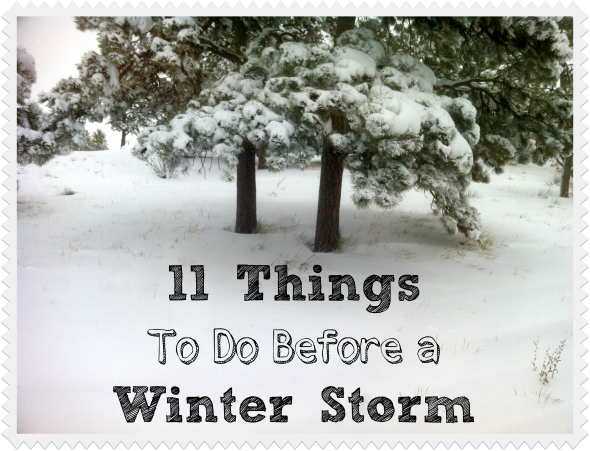
11 Things To Do Before a Winter Storm

Winter Storms are in full swing all over the country. If you are not quite prepared, here are 11 things to do before a winter storm to keep your family safe.
11 Things To Do Before a Winter Storm
  1. Gas up your cars. Its a  good idea to own a quality hand pump gas siphon in case you need to transfer gas to a different tank or put it in a generator.
  2. If you have a gas powered generator, make sure you have plenty of gas stored in safety cans to keep it running for at least 7 days. Gas genenerator owners should turn on their generator and make sure that it is in good working order. It’s not uncommon for them to get all gunked up. Do you have spare parts for it if you need to fix it during the storm? No matter how your generator is powered, its a good idea to have much more fuel than you think you would need!
  3. Go to the store and make sure you stock up on any of the fresh items you may need to top off. You hopefully have plenty of freezer meals as a backup and also a 3 month supply of meals if you needed to draw from your stockpile if you can’t make it to the store or they have run out of supplies.
  4. Read More at  http://simplypreparing.com

How To Build A Solar-Powered Still To Purify Drinking Water


How To Build A Solar-Powered Still To Purify Drinking Water

solar still
The author’s solar still, with one pan in it. The still actually has room for two of these. Note that the glass top is at an angle, allowing the water to flow down to the catch tube.
Everyone agrees that water is needed for survival and articles abound for how to find water and purify it for drinking. But all those articles have one thing in common: They are talking about purifying water from biological hazards.
Normally, the biggest hazards we face from drinking water are microorganisms: bacteria, protozoa and other parasites which can enter our system and make us quite sick. These are a legitimate concern and one that every survivalist must take into account. A case of dysentery can kill you, especially if you are already weakened or injured.

Read more at
http://www.shtfpreparedness.com

Thursday, October 24, 2013

Preparing Makes Sense.


  A summary of  very basic preparations for emergency situations

 
  •     Get a Kit of emergency supplies.

Be prepared to improvise and use what you have on hand to make it on your own for at least three days, maybe longer. While there are many things that might make you more comfortable, think first about fresh water, food and clean air.

Recommended Supplies to Include in a Basic Kit:

  •  Water one gallon per person per day, for drinking and sanitation
  •  Non-perishable Food at least a three-day supply
  •  Battery-powered or hand crank radio and a NOAA
  •  Flashlight and extra batteries
  •  First Aid kit
  •  Whistle to signal for help Filter mask or cotton t-shirt, to help filter the air
  •  Moist towelettes, garbage bags and plastic ties for personal sanitation
  •  Wrench or pliers to turn off utilities
  •  Manual can opener if kit contains canned food Plastic sheeting and duct tape to shelter-in-place
  •  Important Family Documents 
  • Items for unique family needs, such as daily prescription medications, infant formula or diapers
Consider two kits. In one, put everything you will need to stay where you are and make it on your own. The other should be a lightweight, smaller version you can take with you if you have to get away

  •  Make a Plan for what you will do in an emergency.

Plan in advance what you will do in an emergency. Be prepared to assess the situation. Use common sense and whatever you have on hand to take care of yourself and your loved ones.

Develop a Family Emergency Plan. Your family may not be together when disaster strikes, so plan how you will contact one another and review what you will do in different situations. Consider a plan where each family member calls, or e-mails, the same friend or relative in the event of an emergency. It may be easier to make a long-distance phone call than to call across town, so an out-of-town contact may be in a better position to communicate among separated family members. Be sure each person knows the phone number and has coins or a prepaid phone card to call the emergency contact.

You may have trouble getting through, or the phone system may be down altogether, but be patient. Depending on your circumstances and the nature of the attack, the first important decision is whether you stay put or get away. You should understand and plan for both possibilities. Use common sense and the information you are learning here to determine if there is immediate danger. Watch television and listen to the radio for official instructions as they become available.

  •  Create a Plan to Shelter-in-Place 

There are circumstances when staying put and creating a barrier between yourself and potentially contaminated air outside, a process known as sheltering-in-place and sealing the room can be a matter of survival. If you see large amounts of debris in the air, or if local authorities say the air is badly contaminated, you may want to shelter-in-place and seal the room.
 Consider pre-cutting plastic sheeting to seal windows, doors and air vents. Each piece should be several inches larger than the space you want to cover so that you can duct tape it flat against the wall. Label each piece with the location of where it fits. Use all available information to assess the situation.

Quickly bring your family and pets inside, lock doors, and close windows, air vents and replace dampers. Immediately turn off air conditioning, forced air heating systems, exhaust fans and clothes dryers. Take your emergency supplies and go into the room you have designated. Seal all windows, doors and vents.

Understand that sealing the room is a temporary measure to create a barrier between you and contaminated air. Watch TV, listen to the radio or check the Internet for instructions from local emergency management officials.

  •  Create a Plan to Get Away.    

Plan in advance how you will assemble your family and anticipate where you will go. Choose several destinations in different directions so you have options in an emergency. If you have a car, keep at least a half tank of gas in it at all times. Become familiar with alternate routes as well as other means of transportation out of your area.

 If you do not have a car, plan how you will leave if you have to. Take your emergency supply kit, unless you have reason to believe it is contaminated and lock the door behind you. Take pets with you if you are told to evacuate, however, if you are going to a public shelter, keep in mind they may not be allowed inside.

 If you believe the air may be contaminated, drive with your windows and vents closed and keep the air conditioning and heater turned off. Listen to the radio for instructions. Know Emergency Plans at school and work.

Talk to your children’s schools and your employer about emergency plans. Find out how they will communicate with families during an emergency. If you are an employer, be sure you have an emergency preparedness plan. Review and practice it with your employees.

A community working together during an emergency also makes sense. Talk to your neighbors about how you can work together.

Saturday, October 19, 2013

DIY Survival Candles


Low Dough (dollar) way to prepare for no power. Very easy and extremely affordable!


                                                DIY Survival Candles


Candles are an easy-to-use source of emergency lighting and a little bit of heat. I'm shocked to see some of the prices that are charged for long burning candles sold for survival or emergency preparedness - if you want to buy a dozen or so candles, the cost really starts to add up.

Never fear! You can make your own survival candles at home for cheap, using high-quality, long burning soy wax. It's an easy project - the materials are easy to buy and you won't need any specialized tools.


The materials you will need are:
  • Soy wax flakes. These are commonly used in making scented candles and are sold in craft stores or Amazon. I bought a 5 pound bag from Amazon for 12.79 shipped - right here. A pound of wax will fill around a 24 ounce container, give or take. You can use other wax, but soy is affordable, typically has a longer burn time than other waxes and has some other beneficial qualities (all-natural, renewable, etc.).
  • Canning jars. I purchased a dozen 8 ounce jars from Wal Mart for around $8. If you have jars around the house, no need to buy 'em. We've used jars from jams, sauces and so on for candles in the past.
  • Wicks and Tabs. You can find these on Amazon, eBay and at your craft stores. You'll want your wicks to be a bit longer than your candle holder is tall. I have 100 tabs and 100 nine inch wicks on eBay for about $10 total.
The tools you will need are:


  • Scissors: For cutting the wicks to size
  • Double Boiler: For melting the wax. I don't have an actual double boiler, so I just get a large pot, fill it about 1/3 to 1/2 of the way with water, and then nest a slightly smaller pot inside.
  • A Pouring Device: I just used a pyrex measuring cup. 
  • Protective Gloves: We'll be using boiling water and hot wax, so you want to keep you hands safe.
The steps are simple.
First, you'll want to get your wicks ready. If your wicks are way too long for your container, you'll want to trim them down to approximate size. I had 9" wicks here. Insert the wick into the tab - I found it helpful to use my Leathman to "tighten" the mouth of the tab around the wick, but it's not a must. If you buy pre-tabbed wicks then you can skip this part.


Put your wicks in the jars. Don't worry if they're not centered - we'll fix that after we pour the wax. Now it's meltin' time!

This is my "double boiler." Works well enough. Using a double boiler helps melt the wax gently, avoiding risk of it catching fire, burning, etc. You could probably do it without, but it's not hard to improvise so why not?


Here are the flakes beginning to melt.


And now fully melted.


Carefully transfer the melted wax into your pouring container. Then, pour away! Don't worry about the container - soy wax is all natural, non-toxic and cleans up fairly easily. Beware if you have a soy allergy, though.

Don't fill the jar up the whole way - leave some room between the wax and the top of the container. You'll want to center the wicks at this point. Then, take a break and let the wax cool and harden up. Almost done!


Last step. After the wax has cooled, trim the wicks as needed--you want the wick to be about 1/4" above the wax. Then, screw the lids on and you're ready for storage!

While some advertise 70+ hours of burn time for 8 ounce candles like this, they're more in the ballpark of 40 to 50 hours, and you'll get the most life out of them if you burn the candles four hours at a time. Since you would only use the candle for about 4 hours every evening, a single candle should last for around 10 days of regular use. Not bad! You can of course use different sized jars--bigger for longer burn time, or multiple wicks for more light.

Including the purchase of new jars, my cost per candle is around $1.62. With recycled jars, it's under a dollar.

These aren't crap materials, either--these are the same quality of materials use for high-end aromatherapy candles that sell for $20 a pop. Another plus - the combination of soy wax's lower melting point and the protective glass jar make this a safer source of light when compared to other candles, oil lanterns and so on.

One modification that I plan to make it to include a booklet of matches inside of each jar - cheap and makes sure you've got a way to light the candle if it's pulled out of storage during a power outage, etc.

Anyways, give it a shot and let us know how it goes! Have fun!

Thanks and credit for this entire post and photo's go to 


www.streetsmartoutfitters.com